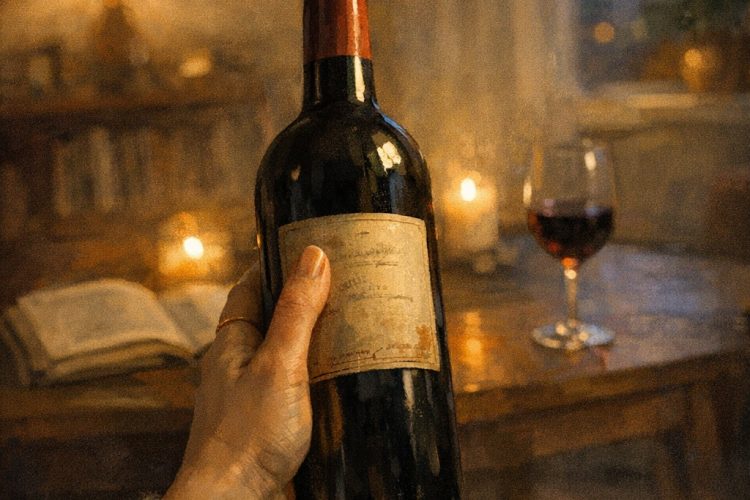
There is a bottle on my shelf I have been meaning to open for three years. It is not famous. It is not expensive. But every time I reach for it, something holds my hand back — a quiet whisper that says: not yet.
I bought it on a rainy afternoon in a small shop in the old town, from a man who didn’t say much but wrapped it in tissue paper as though it were something fragile and sacred. He told me only one thing: “This one needs time.” I nodded without really understanding. I was in a hurry. I almost always am.
The bottle has moved with me. From one apartment to another. It has survived two cities, one breakup, a new beginning. It sits in the same spot, slightly dusty, leaning just a little to one side. Sometimes I think it watches me from across the room.
What it means to wait
We live in a world that rewards immediacy. Wine, quietly, refuses this logic. Certain bottles simply will not perform before their moment. Open a young Barolo too soon and it meets you with its fists — tight, tannic, closed. It is not rude; it is unready. Come back in five years, in ten, and it will welcome you like a different person entirely.
But even wines that are not designed for cellaring ask something of us. They ask us to slow down in the act of drinking them. To notice. To not drain the glass while scrolling through something. To actually be there.
“The best bottle I ever had was one I almost didn’t open — one I had been saving for a reason that never came. In the end, the reason was Tuesday.”
I have a friend who keeps a notebook of wines she has opened and when and with whom. Not scores. Not tasting notes. Just the occasion. A birthday. A reconciliation. A Tuesday that turned out to be important for reasons she didn’t understand yet. Reading it back, she says, is like rereading a diary — except the diary smells of cedar and violet and old earth.
The wine that changed while you weren’t looking
Here is something wonderful and slightly unsettling about wine: it keeps changing even after you’ve bought it. While it sits in your darkness, in your silence, tiny chemical symphonies are playing out. Tannins are softening. Esters are forming. The color is shifting, imperceptibly, toward amber at the edges.
The wine you bought is not the wine you will open. Something will have happened in between. A little death, a little birth. This is not metaphor. This is chemistry becoming philosophy.
And isn’t this true of most things worth having? The conversation you’ve been putting off. The book on the nightstand. The apology that keeps not finding its moment. The longer you let them wait, the more they change — sometimes for the worse, but sometimes into exactly what they needed to become.
On choosing the moment
Sommeliers will tell you there are ideal drinking windows. And they are right, technically. But wine is not only technical. I have opened a “past its peak” bottle at a kitchen table with old friends and had it be the most alive thing in the room. I have opened a perfect vintage alone on a cold evening and felt nothing.
Context is part of the wine. The people around the bottle, the light in the room, the thing someone said just before the cork came out — these are ingredients too. You cannot separate the liquid from its moment.
Which means: there is no universally right time to open a bottle. There is only your time. The time when something in you recognizes the occasion — not because it is grand, but because it is real.
So what about my bottle?
I think I will open it soon. Not for any particular reason. Perhaps that is the point — perhaps the lesson it has been teaching me, all these years, is that I do not need a reason. That ordinary evenings deserve the wine I have been saving for something better.
There is no better. There is only now, and the glass, and whoever happens to be nearby, and the quiet attention you bring to the first sip.
The man in the shop said it needed time. I think it got it. I think maybe I did too.